
Holy Communion Saturday 11 July 2026
Isaiah 6:1-8
Psalm 93
Matthew 10:24-33
I saw the LORD…
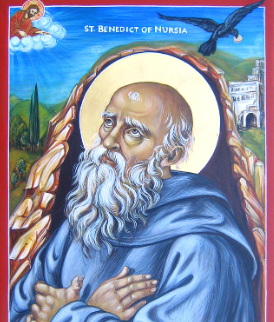
Today we give thanks to God for the life and witness of St Benedict. I have to admit that I don’t know terribly much about his life. But I think that is perfectly appropriate for a Christian: instead of being famous for he was, he is famous for how he helped people get closer to God.
He was a monk and created a routine for his daily life that is called a “rule”. And so, we get the “Rule of St Benedict”. Seven times a day he would stop what he was doing and went into the chapel to pray. These times of prayers were structure: there were readings from the Bible (as well as always something from the Psalms), prayers that reflected the time of day in which he was praying, and prayers that reflected what type of specific help he needed for that time of day. As well as this, there were prayers for other people.
His Rule became so popular it set the standard for Christian monastic living. Everyone started doing it. As a matter of fact, my internet is currently clogged with news about the recently released new translation of the Roman Catholic “Hours” book, their “prayer book” which only exists because of what St Benedict laid down in the 6th century.
When the Church of England went through the Reformation, it wasn’t really a rejection of Papal authority, so much as reverting back to how the English church always had operated: they respected the bishop of Rome, because so much important Christian history is centred around that city. The tradition of Christians everywhere flows in and out of Rome so easily one cannot just chuck everything out just because you don’t like one thing in particular. As a result, when the Archbishop of Canterbury Thomas Cranmer thought about how best to reform the English Church, he did so by writing a prayer book – very much influenced by St Benedict.
Instead of seven prayers a day, we have two: Morning and Evening. And it is not just for monks: every Christian is encouraged to do this. The reason why is because of why Christians do anything: we want to get closer to God. A disciplined life of regular times of prayer has helped the saints in the past get closer to God, and so we ought to learn the lessons they are teaching us.
One thing in particular I like about our Anglican prayer tradition is the philosophy behind “common” prayer. You will notice all our prayers use “we” and “us” language, instead of “I” and “me”. This is because when you pray Morning and Evening prayer, you are not praying it alone. You are praying with Christians all over the world – Anglicans in England, America, Rwanda, Korea, The Maldives are all praying using their Prayer Book, and we are gathered in spirit around the throne of God.
Speaking of the throne of God, I want to just lastly make a reflection on our first reading. Isaiah is being called up and given the job of being God’s prophet. As part of his recruitment interview, he sees this glorious vision of heavenly worship. Angels are surrounding the throne of God, covering their faces and feet in humble modesty before God, singing his praises. This glorious vision of what is currently happening in heaven is where we go when we come before God in prayer. And it is what happens when we gather around the Lord’s Table to celebrate Holy Communion.
When we say “Holy, Holy, Holy Lord” we are saying words that Christians have been saying in their Holy Communion service since the very beginning: our most ancient orders of service include this. It is because they recognised, and we recognise with them, that when we come before God in prayer, we are coming into that heavenly place, in spirit, there and then. It is a glorious, terrifying, awe-inspiring, humbling, joyful moment. That is also why I bow during those words (which is another ancient Christian tradition). This image of heavenly worship is one of the clearest descriptions we have of what is happening at that moment. We join the angelic throng, praising God in the same words that they do.
And so let us give thanks to God for St Benedict and his Rule, which has blessed and continues to bless so many Christians in their spiritual growth. And let us especially praise God for giving us these word-pictures of what is happening when we come before him in prayer. Because at the end of the day, we are all wanting to get close to God. God has given us all these ways to do this, because in Christ we see God’s great desire: that none should perish, but that all people turn to him and live. Hosanna in the highest!