
Homily for St Mary Magdalene, Wednesday, July 22, 2026
Song of Songs 3:1-4a
Psalm 63
2 Corinthians 5:14-21
John 20:1-18
This morning we remember before God St Mary Magdalene. And the readings all speak of a great love – and so I think this is where we should direct our thoughts on this day.
In particular, I want to consider Song of Songs, and this line: “I found him”. Now, when we read Songs, we should keep in mind why it was originally written, and for what purpose. I was ministering at a young adults camp recently, and some young women were lamenting that there was nothing in the Bible that gave them advice on the biggest issue they were facing in their lives: that is, dating advice! Enter the book of Songs. It is in the genre of an ancient Near Eastern erotic love poem; but there is this phrase repeated throughout the book by the author:
I adjure you, O daughters of Jerusalem...
...that you not stir up or awaken love
until it pleases.
The author is a woman, writing about the type of man these young women (the “daughters of Jerusalem”) should be looking for. It is, in effect, an appeal to young women to have high standards in their dating life.
And so that is what it is about primarily. But if we were to take love itself – the concept of love, in its full divine sense – and see what conclusions about it we can draw from how Songs refers to it, I think we learn something about the love of the Lord for us.
Think of this line: “I found him”. Have you found him? Have you, as the Psalmist sings, tasted and seen that the Lord is good? (Ps 34:8) Then I think you may have a sense of what this must have been like for the author of Songs when she went out to look for “him whom my soul loves”, and then found him. In Jesus Christ we have such an endless ocean of the type of love found nowhere else. There is both quantity and quality. And having tasted that love, we say “I found him”. There is no other love that can come even close to the love of our Lord for us.
So that is the first reflection: remember the great love of the Lord for you.
But if I want to have more of it, what should I do?
There is one single competitor for our love. One person above all others that competes with Jesus for our love. Can you guess who it is? It is ourselves.
Whether you think you are wonderful or whether you think you are useless it doesn’t matter. The point is this: when you are deeply, madly in love, all you can think about is the person you are in love with. And so who are you thinking about more? Jesus, or yourself? That will tell you who is winning your heart. What then is to be done? How can we redirect our hearts towards the great Lover?
I thought about the opposite of love. What is the direct opposite of love – and if I can look at myself that way, then I will open myself up for more of the love of Jesus. I don’t think the opposite of love is hate, and so the answer is not to hate ourselves. (In fact, I would suggest hate is merely a side effect of misguided love.) Rather, I think the opposite of love is indifference. To love is to have a strong attachment; to not love is to not have any attachment at all.
So let us be indifferent to ourselves. My body is not my own – it is the temple of the Holy Spirit, bought with a price. (1 Cor 6:19-20). My soul is not my own – the faith that saves it is a gracious gift of God. (Eph 2:8-9) Whenever we think of ourselves, let the thought come, observe it with an aristocratic detachment, and let it go on its merry way. Because “I found him”, the true lover, the true source of love, the One who loves me with an everlasting love that no other love can top.
Homily for Holy Communion at Beaumont Friday 17 July 2026
Holy Communion for Beaumont, Friday 17 July 2026
Matthew 12:1-8
I was listening to a conversation recently about what type of people should go to church. It is a good question: who should go to church?
The conversation concluded that the type of people who should go to church are the people who don’t think they are ready to talk to God. If you don’t think you’re ready to go to church, you should go to church!
This is because of who God is, and what he is like. God is not the type of God who turns people away. God does not ask us to pass a Bible test. God loves it when we just start talking to him.
Jesus is walking through some grain fields when this question comes up. If you have ever been outside of the inner city, you can probably imagine it: big fields filled with crops ready for harvest, and he and his friends are walking through them, running their hands through the plants. Every now and then one of them will grab on and pull some of the grain off and have a bit of a munch.
The problem is, you are not supposed to do this. You are not allowed to go out into the fields on the Sabbath, because it looks too much like work, and you are not allowed to work on the Sabbath.
But Jesus responds in a way that shows he thinks that it is more important that people eat than whether they eat in the right way.
And because he starts talking about priests and the temple, it shows that he is also talking about how we relate to God.
So I wonder: do we think there is anything we should be doing before we start talking to God? Is there some sort of special head-space we need to be in? Do we need to wait until we “feel” something before we talk to God?
Jesus tells his critics that God desires mercy, not sacrifice. Sacrifice is about doing something before talking to God. Mercy is about talking to God whether you think you’re ready or not, and knowing that God loves you anyway.
I want to give you one challenge, and one encouragement. The challenge is this: find a time you think it is inappropriate to talk to God, and start talking to him anyway. The encouragement is this: remember that God doesn’t care about whether it is appropriate or not; what is more important is that you have started talking to him. This is because he loves us all very much, and he wants us to spend time with him, and it brings him joy. And what is more wonderful than rejoicing with God?
Homily for Holy Communion Wednesday 15 July 2026
Homily for Holy Communion Wednesday, 15 July, 2026
Isaiah 10:5-7, 13-16
Psalm 94:8-15
Matthew 11:25-27
Revealed to little children.
The theology we teach to children is pretty good when it comes to God. We manage to fit so much into simple songs: “My God is so big, so strong and so mighty, there’s nothing my God cannot do. That’s true!”
So while it is a great comfort to know that God is in control (because God loves us so much and only wants the best for us), we might also get a bit curious about him, and want to flesh out our faith with some more understanding.
The prophet Isaiah is correcting the king of Assyria and his assumptions. This king is a mighty warrior, and has conquered nation after nation. Now he turns his sights on Israel, and expects another victory. His problem is that he thinks his victory is his own, when he says:
“By the strength of my hand I have done it,
and by my wisdom, for I have understanding;
I remove the boundaries of peoples,
and plunder their treasures;
like a bull I bring down those who sit on thrones.” (Isaiah 10:13)
This is not the case. God is using the king of Assyria to remove the wickedness from Israel; this king is merely an axe in the hand of God, used to clear out the weeds of iniquity. The Assyrian king is not a supreme warrior laying waste, but rather a surgeon’s scalpel whom God is using to remove the tumour, leaving the rest of the body healthier for it. God’s people will be brought safely through, as the Psalmist sings:
For the Lord will not forsake his people;
he will not abandon his heritage; (Psalm 94:14)
And so the boasts of the Assyrian king are nothing but wasted breath, when God replies:
“Shall the axe boast over him who hews with it,
or the saw magnify itself against him who wields it?” (Is 10:15)
It is clear, then, that the king of Assyria did not understand God. But who can understand God?
Jesus has this little prayer in the middle of some ministry that we heard today in our Gospel reading, when he says,
“I thank you, Father, Lord of heaven and earth, that you have hidden these things from the wise and understanding and revealed them to little children; yes, Father, for such was your gracious will.” (Matt 11:25-26)
Reading about the king of Assyria in this context, then, makes Jesus sound almost sarcastic. The “wise and understanding” have the things of God hidden from them – they must not be that wise after all! Yet it is “little children” to whom God reveals himself.
When we try to understand God, we can run the risk of thinking along the lines of those who are “wise” according to the way of the world. They sit in rooms on comfy chairs and think using big words, or they sit on thrones surrounded by mighty warriors and think about big military victories. But Jesus tells us it is the little children to whom God reveals himself.
If the little children are the one to whom God reveals himself, then let us think of ourselves as little children. I am always impressed by their energy – it is as if they wake up each morning filled with excitement about what wonderful surprises and adventures might be in store for them. They don’t hold a grudge – they are always more ready to forgive and get on with the fun than they are to wallow in self-satisfying misery. And their imaginations are like nothing else. Where is our imagination? Where are the dragons that need slaying, the damsels that need rescuing, the rocket ships that are taking them to fantastical new worlds in our lives?
The Assyrian king had set himself up as the be all and end all. Yet he missed out on the most important bit: where God was leading him. Jesus has told us that it is little children that can understand this the most. Let us humble ourselves, not in misery, but with the joy and excitement of little children set free from the classroom, ready to go out and explore this big wide world God has given us to play in.
Homily for Holy Communion Tuesday 14 July 2026
Homily for Holy Communion Tuesday 14 July 2026
Isiah 7:1-9
Psalm 48:1-8
Matthew 11:20-24
The mighty works of God.
I am told that, in an earlier generation, the evangelical cry of the Church was something along the lines of “God is alive and well!” It was a response to the great cultural heavings of the 1960’s and 70’s, when people were rejecting God en mass and creating their own ideas of who we are and how we ought to live.
This idea, that God is alive and well, is a good response to the worries and concerns raised by both the prophet Isaiah as well as our Lord in today’s two readings. The prophet is talking to the king and his cronies, who see oncoming armies and, as a result, their “hearts shook as the trees of the forest shake before the wind”. (Is 7:2) Their enemies have “devised evil” against them, yet they are told “be careful, be quiet, do not fear, and do not let your heart be faint”. (v. 4) Then the prophet stands aside to let God speak: “It shall not come to pass”. (v. 7)
Fear surrounds us on every side. Or, the potential for fear does, at least. Because if God were not alive and well, then what hope would we frail and fickle humans have? But God is alive and well, and he speaks, and he speaks comfort to us and doom to the enemy.
In our Gospel passage, the Lord Jesus is pronouncing woes upon the cities who, upon hearing the Gospel, have not turned back to God. He talks about “mighty works” performed in them, works that they ignored. (Matt vv. 21, 23) Indeed, if Sodom, that city of such evil and wickedness that ended up being wiped out completely (and is still a wasteland to this day) had experienced the mighty works of which Jesus speaks, then they would have repented and believed, and it would still be here.
Again, there is this undercurrent of an idea that God is alive and well, and is active among us, doing things, and pointing us back to him. It is up to us whether we watch and listen and respond.
As Christians, we have seen and heard something of God, and have responded in faith. At the same time, we should continue watching and hearing and responding. Our relationship with God is ongoing. He is still doing things in our lives and in our world; he is still talking to us; we still have things we need to turn away from. Our readings this morning remind us of two important things: first, as the prophet said so many years ago, that when fear surrounds, we are to listen to God speaking peace to us. He is our fortress and mighty defender, and there is nothing we need to fear. And from our Lord, we can take the reminder to ourselves to keep watching and listening for when God is doing things around us. Because he is alive and well, and he isn’t done with loving us and renewing us – and he never will!
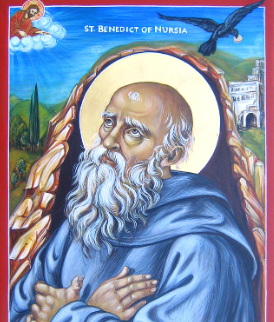
St Benedict of Nursia, abbot (d. 550)
Holy Communion Saturday 11 July 2026
Isaiah 6:1-8
Psalm 93
Matthew 10:24-33
I saw the LORD…
Today we give thanks to God for the life and witness of St Benedict. I have to admit that I don’t know terribly much about his life. But I think that is perfectly appropriate for a Christian: instead of being famous for he was, he is famous for how he helped people get closer to God.
He was a monk and created a routine for his daily life that is called a “rule”. And so, we get the “Rule of St Benedict”. Seven times a day he would stop what he was doing and went into the chapel to pray. These times of prayers were structure: there were readings from the Bible (as well as always something from the Psalms), prayers that reflected the time of day in which he was praying, and prayers that reflected what type of specific help he needed for that time of day. As well as this, there were prayers for other people.
His Rule became so popular it set the standard for Christian monastic living. Everyone started doing it. As a matter of fact, my internet is currently clogged with news about the recently released new translation of the Roman Catholic “Hours” book, their “prayer book” which only exists because of what St Benedict laid down in the 6th century.
When the Church of England went through the Reformation, it wasn’t really a rejection of Papal authority, so much as reverting back to how the English church always had operated: they respected the bishop of Rome, because so much important Christian history is centred around that city. The tradition of Christians everywhere flows in and out of Rome so easily one cannot just chuck everything out just because you don’t like one thing in particular. As a result, when the Archbishop of Canterbury Thomas Cranmer thought about how best to reform the English Church, he did so by writing a prayer book – very much influenced by St Benedict.
Instead of seven prayers a day, we have two: Morning and Evening. And it is not just for monks: every Christian is encouraged to do this. The reason why is because of why Christians do anything: we want to get closer to God. A disciplined life of regular times of prayer has helped the saints in the past get closer to God, and so we ought to learn the lessons they are teaching us.
One thing in particular I like about our Anglican prayer tradition is the philosophy behind “common” prayer. You will notice all our prayers use “we” and “us” language, instead of “I” and “me”. This is because when you pray Morning and Evening prayer, you are not praying it alone. You are praying with Christians all over the world – Anglicans in England, America, Rwanda, Korea, The Maldives are all praying using their Prayer Book, and we are gathered in spirit around the throne of God.
Speaking of the throne of God, I want to just lastly make a reflection on our first reading. Isaiah is being called up and given the job of being God’s prophet. As part of his recruitment interview, he sees this glorious vision of heavenly worship. Angels are surrounding the throne of God, covering their faces and feet in humble modesty before God, singing his praises. This glorious vision of what is currently happening in heaven is where we go when we come before God in prayer. And it is what happens when we gather around the Lord’s Table to celebrate Holy Communion.
When we say “Holy, Holy, Holy Lord” we are saying words that Christians have been saying in their Holy Communion service since the very beginning: our most ancient orders of service include this. It is because they recognised, and we recognise with them, that when we come before God in prayer, we are coming into that heavenly place, in spirit, there and then. It is a glorious, terrifying, awe-inspiring, humbling, joyful moment. That is also why I bow during those words (which is another ancient Christian tradition). This image of heavenly worship is one of the clearest descriptions we have of what is happening at that moment. We join the angelic throng, praising God in the same words that they do.
And so let us give thanks to God for St Benedict and his Rule, which has blessed and continues to bless so many Christians in their spiritual growth. And let us especially praise God for giving us these word-pictures of what is happening when we come before him in prayer. Because at the end of the day, we are all wanting to get close to God. God has given us all these ways to do this, because in Christ we see God’s great desire: that none should perish, but that all people turn to him and live. Hosanna in the highest!